

Quick Summary
SmarDen deployed a machine monitoring system in a large pre-fab manufacturing plant operating heavy welding machines under continuous, multi-shift conditions. The system was built on energy signals, not direct machine data, using Modbus energy meters, IoT gateways, and real-time processing through SmarDen Prime, which is SmarDen’s full-stack Industrial IoT platform.
This enabled clear visibility into machine utilization, shift-level performance comparison, and identification of idle and wasted energy, all without a single machine modification or any production downtime.
What We Were Working With
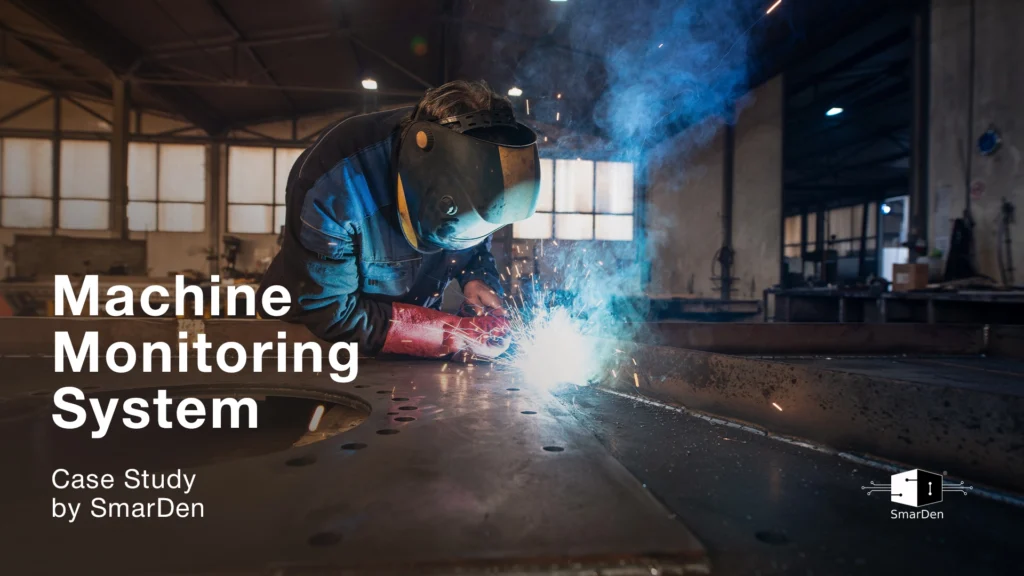
The facility was a large pre-fabrication manufacturing plant located near Faridabad, Haryana. Pre-fab plants operate under intense production pressure. Structures are assembled to order, deadlines are tight and machines run in continuous multi-shift cycles.
The specific challenge involved heavy welding machines. These are high-load, three-phase systems drawing significant power across every shift. They do not provide digital outputs and do not expose structured data of any kind.
The conditions on the shop floor included:
- Continuous operations, with machines running across multiple shifts and no scheduled downtime
- No structured data output, with no machine interface or native telemetry
- Varied electrical layouts, with different machine configurations across sections of the shop floor
- No scope for production interruption, requiring any monitoring solution to be deployed around live operations
This is one of the most common and underserved environments in Indian manufacturing. Thousands of similar plants exist across Haryana, Punjab and the NCR region, operating largely on experience and manual oversight, without structured data to support decision-making.
The Challenges in Monitoring Machines
The client’s requirement was clear: measure machine performance, understand utilization, and identify where energy is actually being used versus wasted.
But the standard approaches to machine monitoring didn’t apply here.
Direct machine integration wasn’t possible as there was no PLC, no OPC-UA, no Modbus RTU port on the machines themselves.
Production shutdown for installation wasn’t an option, these machines generate revenue every hour they run.
Manual observation was already happening but wasn’t scalable. Supervisors knew when machines were running. They didn’t know for how long, at what load, during which shifts, or compared to what baseline.
The gap wasn’t awareness. It was structured, consistent, actionable data delivered without disrupting a single hour of production.
Why Energy Data Alone Does Not Reflect Machine Activity
Before we get to the solution, it’s worth addressing a common misconception: that installing an energy meter solves machine monitoring.
It doesn’t.
Standard energy monitoring gives you electrical readings such as voltage, current, and kWh. These are useful for billing, but not for understanding actual machine behavior.
Here’s the gap:
| Data Available from Standard Energy Meters | Operational Insight Actually Required |
|---|---|
| Voltage and current readings | Is this machine active or idle right now? |
| kWh consumption | What is this machine’s actual utilization rate? |
| Total power draw | Which shift is performing best? |
| Aggregate site energy | Where is energy being wasted, and when? |
The data exists. The interpretation doesn’t. That’s the problem most industrial energy monitoring projects fail to solve.
The Insight That Changed Everything - Electrical Fingerprints
Every machine has an electrical fingerprint.
When a heavy welding machine is actively running a weld cycle, it draws a high, variable load that is spiky and irregular, characteristic of arc welding behavior. When it is idle with an operator present but not welding, it draws a low, steady baseline load. When it is completely off, the load drops to near zero.
These patterns are consistent. They are repeatable. And when captured at sufficient resolution, they reveal the exact operating state of the machine without requiring any direct integration with the machine itself.
| Electrical Pattern | Interpreted Machine State |
|---|---|
| Near-zero load | Machine OFF |
| Low, steady constant load | Idle, powered on but not operating |
| High, variable load | Active, in production cycle |
| Intermittent high-load spikes | Cyclic operation, for example welding arcs |
Once machine states can be reliably identified from energy patterns, raw electrical data becomes operational intelligence. What was a kWh reading becomes machine utilization. What was a power trend becomes shift-level performance. What was an unexplained spike becomes an anomaly worth investigating.
How We Built It - Deploying Machine Monitoring on SmarDen Prime
SmarDen Prime is a full-stack Industrial IoT platform built to connect, process and act on data across industrial environments. It powers applications across manufacturing, energy, infrastructure and operations. In this deployment, machine monitoring was the application and SmarDen Prime was the platform it ran on.
The system was deployed entirely non-intrusively, around existing electrical infrastructure, with no machine modifications and no production interruption.
| Stage | What Happened |
|---|---|
| Data Capture | Modbus energy meters were installed externally at each machine’s electrical panel, capturing voltage, current, power factor, and energy at the machine level. |
| Data Transmission | IoT gateways collected data via the Modbus protocol and maintained continuous transmission to SmarDen Prime across the shop floor. |
| Data Processing | SmarDen Prime processed data in real time, mapped energy patterns to machine states (active, idle, off) and aligned them with machine identities, timestamps, and shift schedules. |
No machine was modified. No shift was interrupted. No production was lost.
From Raw Energy Data to Role-Specific Intelligence Across the Plant
Once the system was live, the same energy data started answering completely different questions, depending on who was looking at it.
For the Plant Head – Productivity Insights
The plant head needed to know which machines were actually being utilized and how utilization compared across shifts. The system surfaced machine-level utilization rates, idle time percentages, and shift-on-shift performance trends. Not energy data. Productivity data.
- Which machines are underutilized?
- Which shift consistently performs better?
- Where is production capacity being lost?
For the Finance Team – Energy Cost Visibility
The finance team needed to understand where energy spend was going and identify waste. The system mapped energy consumption to machine states, so idle energy (machines on but not producing) was clearly separated from active production energy. Wasted energy had a measurable value.
- How much energy is consumed during idle hours?
- What does idle energy cost per shift or per month?
- Where are the biggest opportunities to reduce energy spend?
For the Operations Team – Real-Time Alerts
The operations team needed to act on what was happening in real time, not after the fact. The system delivered alerts for anomalies, unexpected load patterns, machines running outside shift hours, and abnormal behavior before it led to failures.
- Is that machine actually running right now?
- Why did energy spike on a specific line at a given time?
- Which machines are currently idle when they should not be?
Same data. Three different dashboards. Three different stakeholders. All from a single energy signal.
This is exactly the kind of outcome SmarDen Prime is built to enable across industrial applications, turning raw operational data into role-specific intelligence that different teams can act on.
What This Application Delivers in Practice
As a machine monitoring application running on SmarDen Prime, the system provides:
Machine Utilization Tracking
Real-time and historical utilization rates per machine, enabling visibility into how much of each shift a machine was actively producing versus remaining idle.
Shift-Level Performance Comparison
Compare shift A, B, and C on the same metrics to identify underperforming shifts, machine dependencies, and areas where process improvements are required.
Idle Energy Detection
Quantify energy consumed during non-production hours. This is often the most immediate and significant opportunity for reducing energy costs in continuous industrial operations.
Anomaly and Deviation Alerts
Detect unusual energy patterns that may indicate machine wear, incorrect operation, or unplanned machine activity outside defined schedules.
Historical Operational Patterns
Build a reliable record of how the shop floor actually operates, not just how it is expected to operate. This forms the baseline for continuous improvement and decision-making.
Where This Approach Works Best
This energy-signal-based machine monitoring approach is particularly well-suited for:
- Pre-fabrication and structural manufacturing plants, like the one described in this case study
- Metal fabrication and welding environments where machines have no digital outputs
- Automotive and auto-component manufacturing with high machine density and shift-based production
- Heavy engineering and casting facilities with continuous operations and legacy equipment
- Plastics and injection molding with cyclic machines and identifiable energy signatures
- Any facility with legacy machines that cannot be digitally integrated directly
The common thread is simple. These are environments where machines do not provide structured data, production cannot stop and operational visibility is still critical.
Conclusion
A machine monitoring system is not useful because it collects data. It becomes useful when that data reflects how the operation actually runs.
When the plant head can see utilization without asking a supervisor. When finance can put a rupee value on idle hours. When operations gets an alert before a problem becomes a failure.
That shift, from raw energy readings to operational intelligence, is what this deployment achieved in a large pre-fabrication manufacturing plant near Faridabad, built on SmarDen Prime as the underlying Industrial IoT platform. Without modifying a single machine. Without stopping a single shift.
If you are running a manufacturing facility and your machines are still invisible to you, this is where that changes.
Do You Have Visibility Into How Your Machines Actually Perform?
SmarDen Prime is a full-stack Industrial IoT platform that powers a range of industrial applications, from machine monitoring and energy management to multi-site operations and predictive maintenance.
If you are looking to establish visibility into machine performance in your facility, machine monitoring is one of the ways SmarDen Prime can be deployed to suit your operational needs.
FAQs
A machine monitoring system tracks the real-time operational state and performance of industrial machines, identifying whether they are active, idle, or off, and generating insights on utilization, shift performance, and energy patterns.
In this deployment, SmarDen used energy signals captured at the machine level and processed through SmarDen Prime, its Industrial IoT platform, to deliver these insights as one of the platform's industrial applications.
SmarDen installed Modbus energy meters externally at the electrical panel feeding each welding machine. IoT gateways collected this data continuously, and SmarDen Prime processed it in real time, mapping electrical patterns to machine states and aligning them with shift schedules.
The entire deployment was carried out without modifying machines or interrupting production.
Standard energy monitoring tells you how much electricity a machine consumed. SmarDen's machine monitoring tells you what the machine was doing, active, idle or off, and for how long during each shift.
This transforms energy data into operational and productivity intelligence.
Yes. Because the monitoring is built on external energy meters and IoT gateways, it can be installed and configured while machines continue to operate. No downtime is required.
The system provides machine-level utilization rates, shift-wise performance comparison, idle energy quantification, anomaly detection, and historical operational patterns.
These are structured differently for plant management, finance teams, and operations teams based on their specific requirements.
Any facility with legacy or heavy industrial machines that don't provide structured data, including pre-fab manufacturing, metal fabrication, welding, automotive component manufacturing, heavy engineering, plastics and injection molding.
The approach is particularly effective in continuous, multi-shift operations.
SmarDen Prime is SmarDen's full-stack Industrial IoT platform designed to connect, process, and act on data across industrial environments.
It supports a range of applications including machine monitoring, energy management, multi-site operations and more.
In this case study, machine monitoring was deployed as one of those applications, using SmarDen Prime's data ingestion, real-time processing, and reporting capabilities.